
Background
The customer is an engineering and construction company in transport infrastructure, and its business includes producing precast concrete components. The materials required include prestressing strand, corrugated duct, anchorages and grout, supplied by different industries: metal products, plastic pipe and construction chemicals. Because the components are large and heavy, transport distance is limited and precast yards are usually set up near each project. Each new yard needs a supplier list rebuilt locally.
Procurement difficulties
- Supplier candidates come from existing lists and industry referrals, so the range is narrow when a new category or a new region is involved.
- Quotations are requested one supplier at a time by phone and instant messaging. Records and prices sit with individuals, which makes side-by-side comparison and later tracing difficult.
- Management needs to know, for each batch, which suppliers were asked, how the agreed price deviates from historical prices, and which purchases were single-source. The existing ERP records outcomes, not the enquiry and selection process.
The system
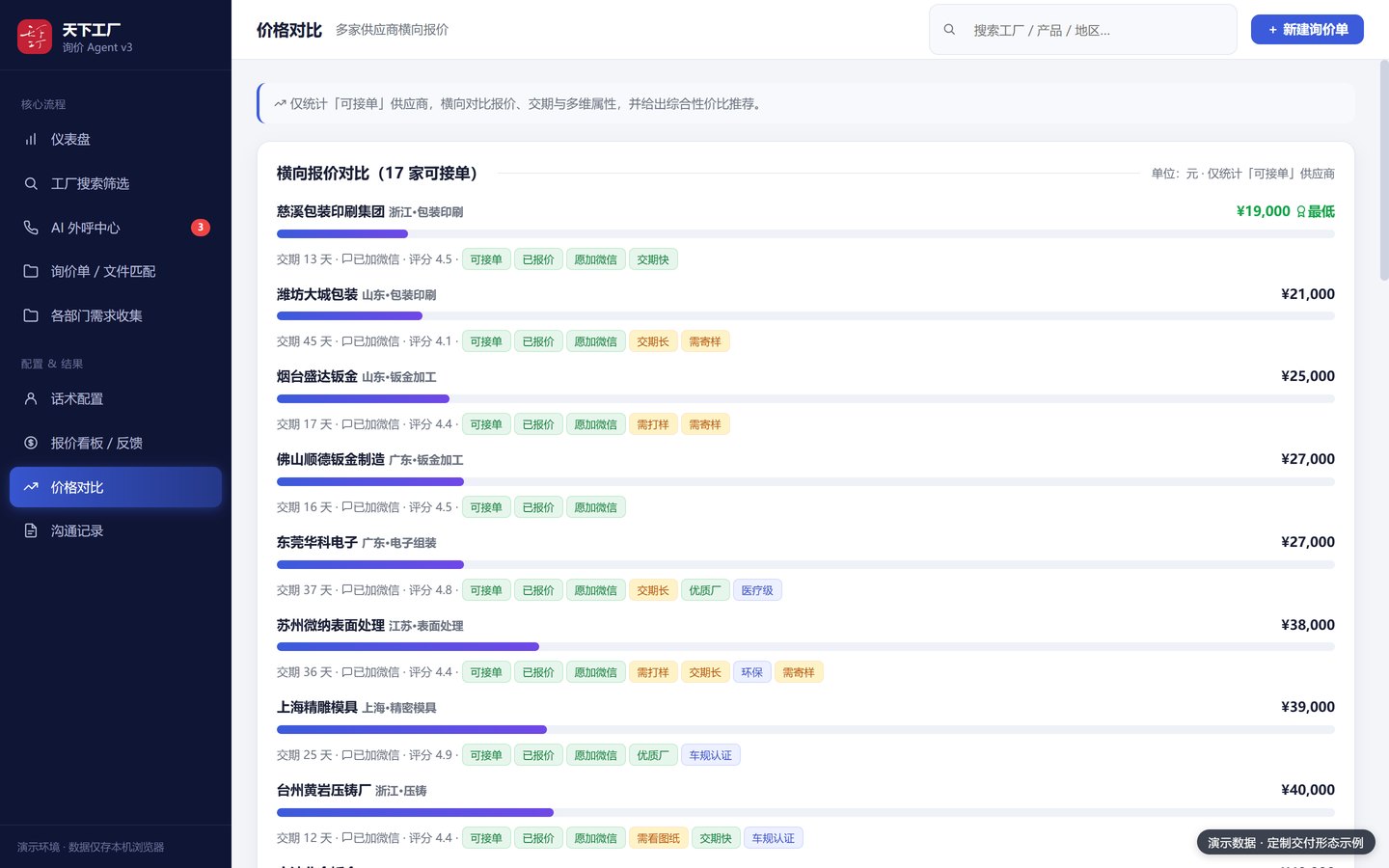
Supplier sourcing. Procurement staff upload a tender document or bill of materials. The system extracts material categories and technical requirements, then screens 4.8 million factory records by category, capacity, credentials and region to produce a shortlist of candidate suppliers.
AI outbound RFQ. AI outbound calling contacts multiple candidate factories in parallel using configurable scripts, confirming willingness to take the order, price and lead time, and guiding suppliers to submit quotations online. Call records, quotations and tags are archived automatically.
Comparison and control. The system compares quotations, lead times and credentials side by side and gives a conclusion with the reasons for selection. A management dashboard shows, for each batch, the range of suppliers asked, the deviation of the agreed price from the historical average, and single-source batches. Supplier admission checks, conflict-of-interest screening and end-to-end logging are available to internal audit.
Relationship to existing systems. The system reads data from the existing ERP and approval workflow and writes results back. The established approval path is unchanged.
Division of work
The system handles repetitive work: screening lists, first-round enquiries and record keeping. Technical clarification, commercial negotiation and the final award remain with procurement staff. The input, output and operator of every step are recorded.
Where it applies
The same approach suits engineering, construction and equipment companies with many material categories, dispersed suppliers and a need to build a supply base in a new region for each project.
The company name is withheld and no customer operating data is disclosed.