
Factory data layer
Tianxia Gongchang · Open platform
About the platform →Manufacturing AI agents
Seven job families, 26 capabilities
View the capability list →Industry AI systems
Smart parks · Intelligent procurement
View the systems ↓Industry research
Tianxia Gongchang Research
Visit the institute →The company is built on a proprietary factory data layer: business profiles of 4.8 million Chinese factories reconstructed from fragmented public information. Four lines of business follow from it — the data layer itself, role-oriented AI agents, industry-oriented AI systems, and industry research grounded in the same data.
Factory data layer: Tianxia Gongchang and the open platform
The Tianxia Gongchang platform
Users search factories on web, mini-program and app. Keyword search, factory profiles, decision-maker contacts and conversational AI search share one dataset and one engine, serving three scenarios:
- Customer acquisition — filter target factory accounts by industry, region, scale, export business and decision-maker contact availability
- Sourcing — find factories capable of a given category and specification, compare across an industrial cluster, and review credentials, scale and operating status
- Company lookup — enter a company name to view its factory profile and contact channels
Data scale:
- 4.8 million factory records — covering products, capacity, customer structure and equipment level, well beyond basic registry information
- 13.95 million anonymized key-person mobile numbers and 5.6 million WeChat IDs
- 1.8 million factories with export business
- 1,000+ industrial clusters — down to township level, including clusters that span cities and provinces
More about Tianxia Gongchang →
The open platform
The same capabilities are available to developers and AI clients over MCP and REST, which share one authentication, billing, rate-limiting and audit mechanism.
Five capabilities are currently open: factory search, factory detail, company contact, factory deep-dive and natural-language factory search. Search intent is an explicit parameter with three values: sales (find customers), purchase (find suppliers) and company_query (look up a specific company); the sell side and the buy side query the same index and fields.
Usage is metered per call, with per-call usage and billing visible in the console. Documentation and sandbox keys are available at the Tianxia Gongchang open platform.
Manufacturing AI agents
Twenty-six capabilities across seven job families: sales, marketing, procurement, planning, finance and legal, export, and market intelligence. Agents read both the factory data layer and the company’s own orders, inventory and documents, and write results back into existing systems. Selected capabilities:
- AI buyer — parses tender documents and BOMs, issues RFQs to multiple candidate factories in parallel and returns a comparison with a recommendation; scores suppliers on on-time delivery and pass rate, and raises a same-day alert when a supplier’s registry or litigation status changes
- AI sales rep — places outbound calls in bulk and grades intent in real time; produces quotations from a cost model and same-day market prices
- AI export specialist — identifies qualified buyers from customs data and trade-show directories and completes decision-maker email and phone; screens export controls, sanctions lists, rules of origin and environmental and labour requirements
- AI intelligence officer — continuously tracks newly registered, newly started and newly commissioned factories nationwide with a daily list; aggregates tender notices across channels and filters them by category
This line is delivered as custom work: a business diagnostic first, one or two high-value scenarios piloted, then custom development and launch, with monthly review. The full capability list is at the AI agent marketplace.
Industry AI systems
Industry AI systems integrate the factory data layer, AI agents and an industry’s own business rules into complete business systems. Two directions are currently covered.
Smart industrial parks
Investment promotion. The system maps the upstream, peer and downstream companies around a park’s anchor industry; each node corresponds to a factory that can be contacted directly. It continuously monitors publicly verifiable relocation, expansion and new-build information, uses AI to pre-assess four landing conditions — premises, approvals, emission quotas and land — and completes the first round of intent conversations through intelligent outbound calling.
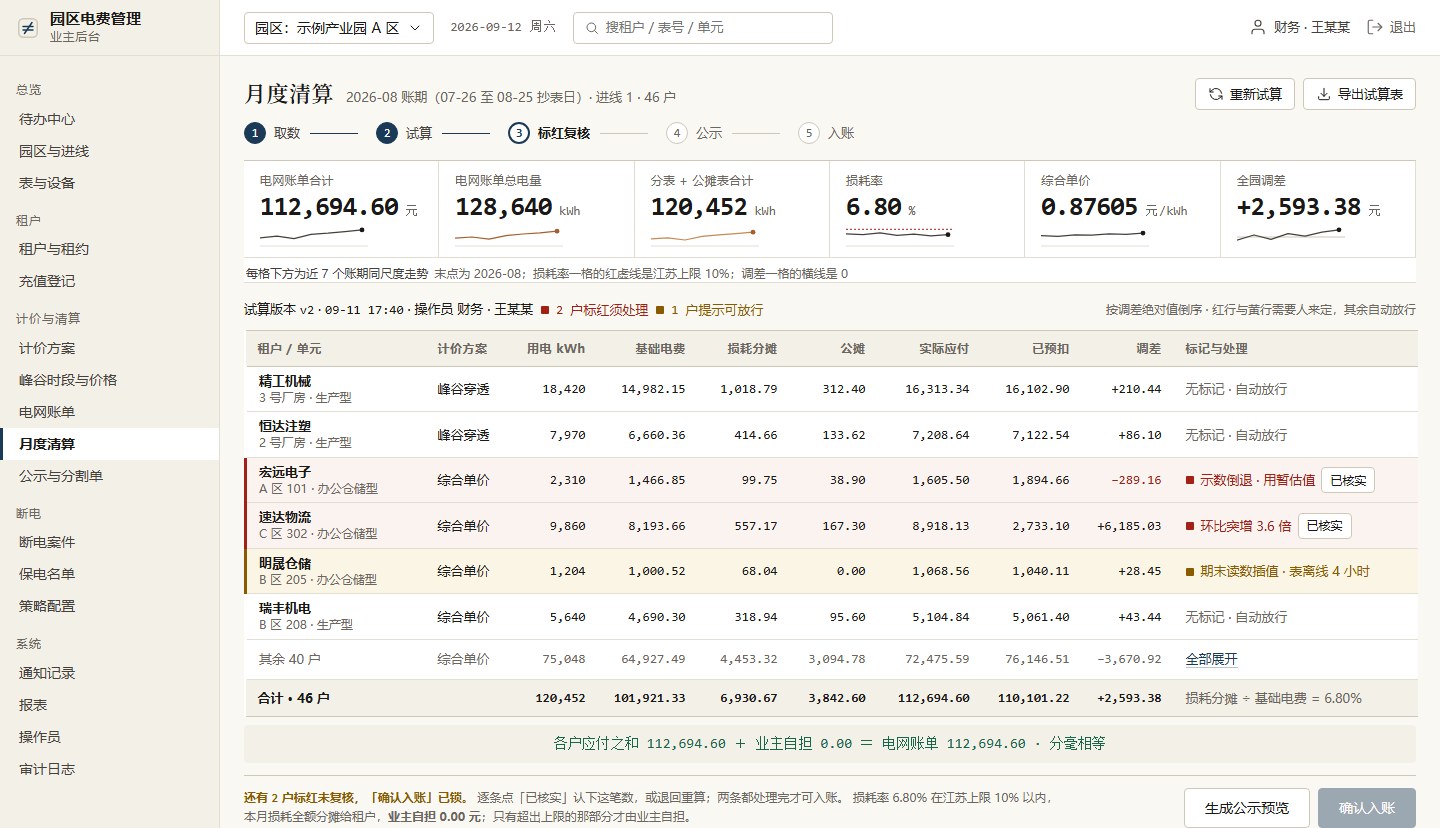
Energy management. Designed for sub-metered parks, where the grid installs a single master meter and the park distributes power to tenants itself. The system performs monthly settlement under each province’s sub-metering policy, allocating the energy charge, line loss, power-factor adjustment and capacity charge of the grid bill to tenants item by item, so that tenant totals reconcile to the grid bill. Prepaid balance management, tiered alerts and tenant-type-specific disconnect policies are fully logged, and tenants can check balances and bill details in a mini-program.
Intelligent procurement
Supplier sourcing. Upload a tender document or bill of materials and the system extracts material categories and technical requirements, then screens the 4.8 million factory records by category, capacity, credentials and region to produce a shortlist of candidate suppliers. For precast concrete components, for example, purchased materials span prestressing strand, corrugated duct, anchorages and grout.
AI outbound RFQ. AI outbound calling contacts multiple candidate factories in parallel using configurable scripts, confirming willingness to take the order, price and lead time, and guiding suppliers to submit quotations online. Call records, quotations and tags are archived automatically; technical clarification is handed to procurement staff.
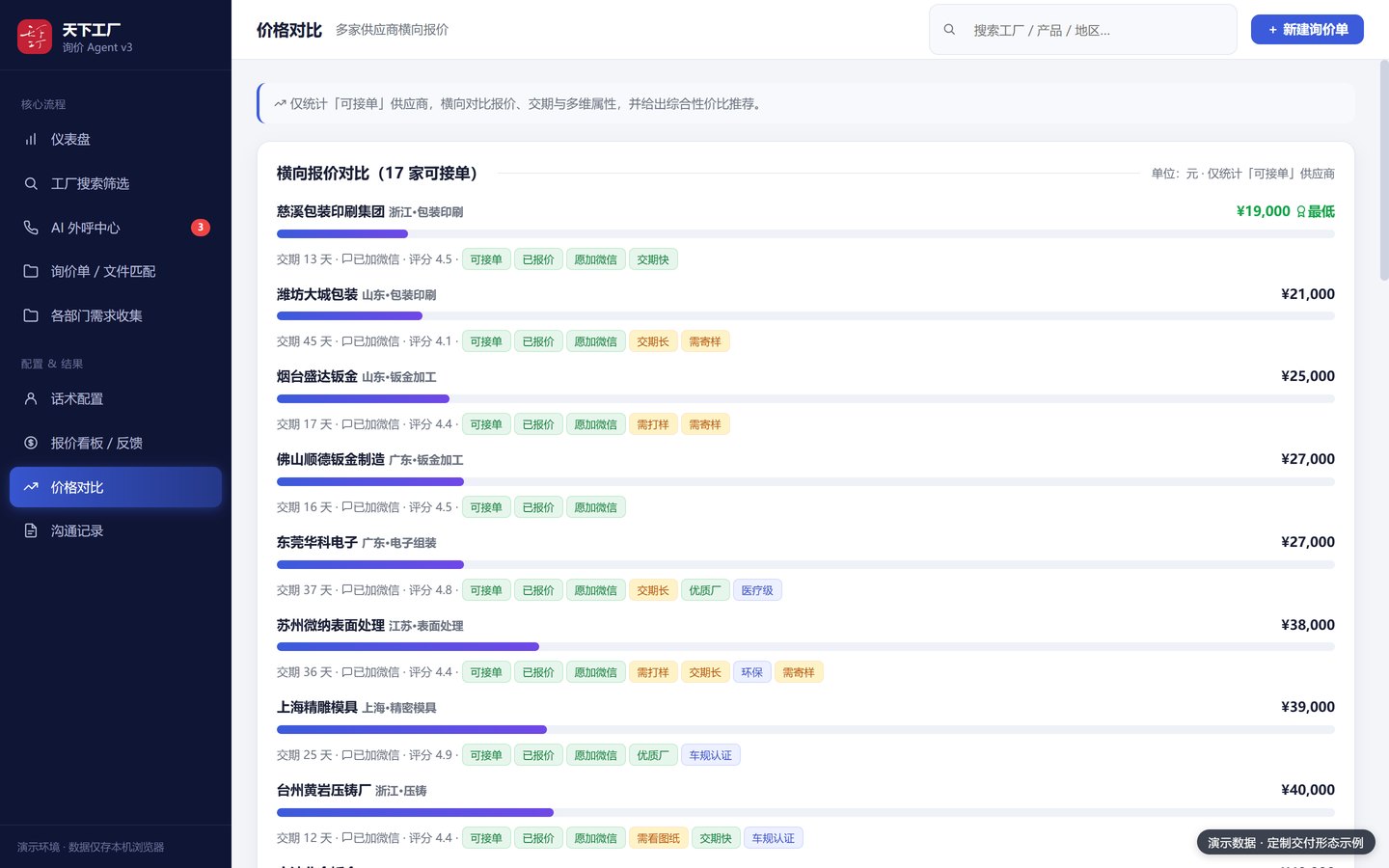
Comparison and control. The system compares quotations, lead times and credentials side by side and gives a comparison conclusion with the reasons for selection. A management dashboard shows, for each batch, who was asked, how the agreed price deviates from the historical average, and which batches were single-source. Supplier admission checks, conflict-of-interest screening and end-to-end logging support internal audit. The system reads data from the existing ERP and approval workflow and writes results back.
Industry research
Tianxia Gongchang Research publishes industry panorama reports, cluster and regional industry maps, and white-paper studies. Research is grounded in the same factory data layer; findings are published openly and may be cited.
Why a factory data layer is hard to build
Unlike consumer goods, factory data has no public APIs, no rating aggregators and no review platforms. Building a reliable layer means solving five problems at once:
- Collection — company websites, patents, job postings, tenders, trade-show directories and corporate publicity all have to be collected independently
- Cleaning — the registered entity and the actual producing entity are often different, for example a listed company and its third-tier subsidiary, a parent and its plant branch, or a brand owner and its contract manufacturer
- Niche classification — the national industry classification is too coarse; long-tail clusters require a non-standard classification down to township level
- Cross-region clustering — township clusters often span cities and provinces and cannot be partitioned by administrative boundaries
- Question-oriented reorganization — restructuring raw data into directly answerable business questions: what the plant makes today, how much capacity it has, who decides, and whether it is worth contacting